 Home
Home
 Blog
Blog
 Featured
 Substack
 Cookbook
 RSS Feed
 Donate
 Other
Other
 Library
 Links
Links
 Webring

About two months ago I ran a 50k. People like to ask me how it was to which I simply say “it was good”, of course I was in pain by the end of it but overall it is something I’d do again, maybe even something I’d recommend everyone do at least once. The other question people like to ask is quite a bit harder to answer, in fact I don’t think I’ve ever actually answered it because I couldn’t explain it. The question is “Why?” more specifically “Why did I run a 50K?” and more significantly “Why do I run?”
The simple answer to the latter question is that it makes me feel good, but to really understand things we have to go back in time a few years.
July of 2023 was about a year after I had quit a physically demanding job and gotten into a much higher paying but much more sedentary job. A year before that I may have been in the best shape of my life able to casually throw hay bales around and chase down a loose animal when the need presented itself. But by that July I had lost a noticeable amount of strength and I wanted it back. On the eleventh I drove straight to Tractor Supply after work and bought two five gallon buckets. The first step in my plan to get back in shape would be to fill those buckets with water and carry them back and fourth in my backyard for long periods of time. I believed it would be a cheap and effective way to get a workout. When I got home I wanted to carry those buckets around for thirty minutes, it was hard, I think I tapped out after fifteen but it was something I was exited to improve.
The next day I was rear ended on my way home from work. When the shock and adrenaline of the accident finally wore off I realized my back was injured. There would be days where it was in so much pain that physically getting out of bed would take several minutes and I’d question if I’d even be able to walk out the door. It would be months before I was allowed to lift more than twenty-five pounds again. Getting back in shape was no longer an option for me, instead the next year was spent slowly getting weaker and weaker, then fatter and fatter.
The interesting thing about gaining weight and losing strength in today’s culture is that nobody else seems to notice or care, or if they do they won’t tell you. Of course I knew I was fat, every once in a while I’d hop on the scale and see a number like 235, which, at my height put, my BMI right at the bottom of the obese range. I was fat, but when I’d tell people that I was fat (which I often did) they’d tell me I wasn’t, that I’m just fine, that negative self talk is bad and stuff like that. We’re used to seeing people around 100 pounds overweight and calling them fat, I didn’t look like someone 100 pounds overweight because I wasn’t, but that didn’t mean that I was “just fine” being and looking 40 pounds overweight.
But what was more important than how I looked was how I felt, and I felt like crap all the time, I hated that. I’ve found that most people really don’t understand the effect being overweight has on how they feel everyday because there aren’t many people who have experienced both being fit and being fat while possessing an adequate level of humility. People who spend their entire lives fit never experience how bad it feels to be fat, I don’t think I can properly explain it but its sort of like you always feel like you have a cold but you don’t. People who spend their entire lives fat never experience how good it feels to be healthy. I know people who grew up fat then lost weight later in life who were surprised at how much better they felt once they were no longer obese.
Of course there are plenty of people who grow up fit only to become fat later. These people remember what it felt like to be young and fit and now understand the physical drain of being overweight. The mistake these many of these people make when looking back at their healthier years is they attribute the good feelings associated with health to youth rather than fitness. I’m in my late 20s as are many of my friends, I, along with many of my friends, have been guilty of saying something like, “I’m too old for that” as a way to avoid of some sort of physical activity or we’ll use our age as our reason why we don’t feel great all the time. In reality people my age don’t have the right to use those kind of excuses, those are reserved for people nearly twice our age.
If you feel like crap all the time when you are twenty-seven, it isn’t because you are twenty-seven, it is because you’ve gained fifty pounds since graduating college. Twenty-seven is the average age of an Olympic athlete you should still be in your prime at twenty-seven.
When I turned twenty-seven I certainly was not in my prime, I was probably in the worst shape of my life. To repeat something I’ve already stated, I felt like crap all the time and I hated it. By that time my back had healed to the point where my injury wasn’t a limitation anymore it was just an excuse. I knew I should be exercising but I wasn’t.
Rucking was something I’d dabble in from time to time. I had heard (and repeated) the claim that it was just as efficient at burning calories quickly as running was, but when I’d throw a pack on and walk around the neighborhood I began to doubt those claims. You can believe anything you want from the internet but if you never put it to the test you will never be able to differentiate fact from fiction. Rucking wasn’t satisfying to me, when I’d get home from a ruck I didn’t feel any sort of accomplishment, I didn’t feel like I had burned a significant amount of energy, so I quit doing it.
Unfortunately I had indoctrinated myself into the cult of rucking, I was closed minded to the idea of running, I thought running would kill me. I stopped rucking and replaced it with nothing. You should never let yourself be closed minded to something as beneficial as running. Luckily I was able to change that terrible mindset. (You can read more about my realization that rucking might not be the best thing here)
I believe it was this video of Cameron Hanes and Courtney Dauwalter casually running 60 miles together that opened my eyes to running. The thought that people could cover that much ground in one day and have fun doing it was absolutely inspiring to me. There is something deep inside of me that craves adventure and I knew that if I wanted to be capable of that sort of adventure I needed to start running.
It was March when I realized I needed to start running. There was a half marathon in June that a few of my friends had run in past years that I figured I could train and be ready for. I asked one of them if she was planning on running it this year because I wanted to run it with her. She wasn’t running it that year but she told me she was signed up for a half marathon in just two weeks that I could try to join her for. I thought about it fairly seriously, one of our friends had run a half marathon without training and I figured if Gary could do it I could do it. When I got home that night I finally went on my first run around the block, it was less than a mile and it was hard, I thought to myself there was no way I could do 13 two weeks later. The race had already sold out by that point so I wouldn’t have the chance to try.
It would be another week or two before I went out and ran again, but April is when I started to take it seriously, I bought a pair of running shoes (I had to buy and return two or three pairs before I found some that worked) and slowly started stacking miles. About one mile a day was where I started (although there were some days where I’d only manage half that). Through May I’d slowly build up distance, I’d start going a mile and a half instead of just one, then I stepped it up to two. I told myself that I wanted to run a 5k every day in June so I was building up to that distance. I didn’t end up achieving that 5k a day goal for June but throughout June and July I was running/walking about three miles fairly consistently with the occasional longer run of four or five miles thrown in.
Throughout this time I was consuming a lot of ultramarathon related content, documentary films following professional ultramarathon runners like King of Moab, The Kid and Walmsley all inspired me. I figured if those extraordinary people could go out and race hundreds of miles at fast paces I could at least do a fraction of that.
My first six mile run happened at some point in the middle of July and it was a great one. I was listening to Creed just as I got to the top of a hill to have a view of the city with the golden rays of the sunset cast over it, I thought to myself “this is what life is for.” That may have been the first time I experienced a runner’s high. When I finished that run I figured I could probably go out and do that all over again if I had a ten minute break.
Pretty soon I’d have the opportunity to test that theory. I was craving the opportunity to run a race so not many days later I was browsing ultrasignup and came across the Mountain Tiger Donner Summit race just one week away. It was advertised as an eleven mile race (in reality it was closer to thirteen) with a single aid station near the halfway point about six miles in, exactly the sort of thing I theorized I’d be capable of. I managed to sign up the last day registration was open. I had a week to prepare.
The Mountain Tiger race was a trail race near Truckee CA, the challenging course would take me to four peaks at high elevation. The distance wasn’t the only new challenge for me, 3,000 feet of climbing across a course that was almost entirely at an elevation over 7,000 feet added to the difficulty. Despite that I was fairly confident I could finish the race (as if I had much of a choice anyways) so I bought myself some trail shoes and a running vest and before I knew it I was in a car driving over the clouds to get to the race.
When I got to the start line I still didn’t really know what to expect, I was confident I could complete the race but when you are faced with something you’ve never done before it is impossible to know how it will go.
The first mile or two went along a relatively flat fire road, my goal was to run that entire easy stretch without walking and I accomplished that goal while packed in with all the other runners. Over time we began to separate and as the road began to climb higher and steeper I could see a bend off in the distance where it appeared to drop back down. I was looking forward to some gentle downhill running to give my legs a bit of a break but right when we hit that bend the pink flags marking the course went off the road and took us up the first big climb of the race. I hadn’t yet earned the downhill I was craving.
After reaching the fist peak in the race we ran along the beautiful Razorback Ridge then up to the second peak before I finally got the good downhill stretch I was craving. I was feeling pretty good by the bottom of that hill. I’d gone about six miles at that point and that was the farthest I had ever run, but the race was only halfway done. I refueled at the aid station and began the longest climb of the day, two miles up a fire road to the summit of Mt. Lincoln. I walked almost that entire climb (that was my plan) and by the end of it I could hardly go ten steps without having to pause and catch my breath (8,000 feet is no joke) but I eventually found the satisfaction of getting to the top.
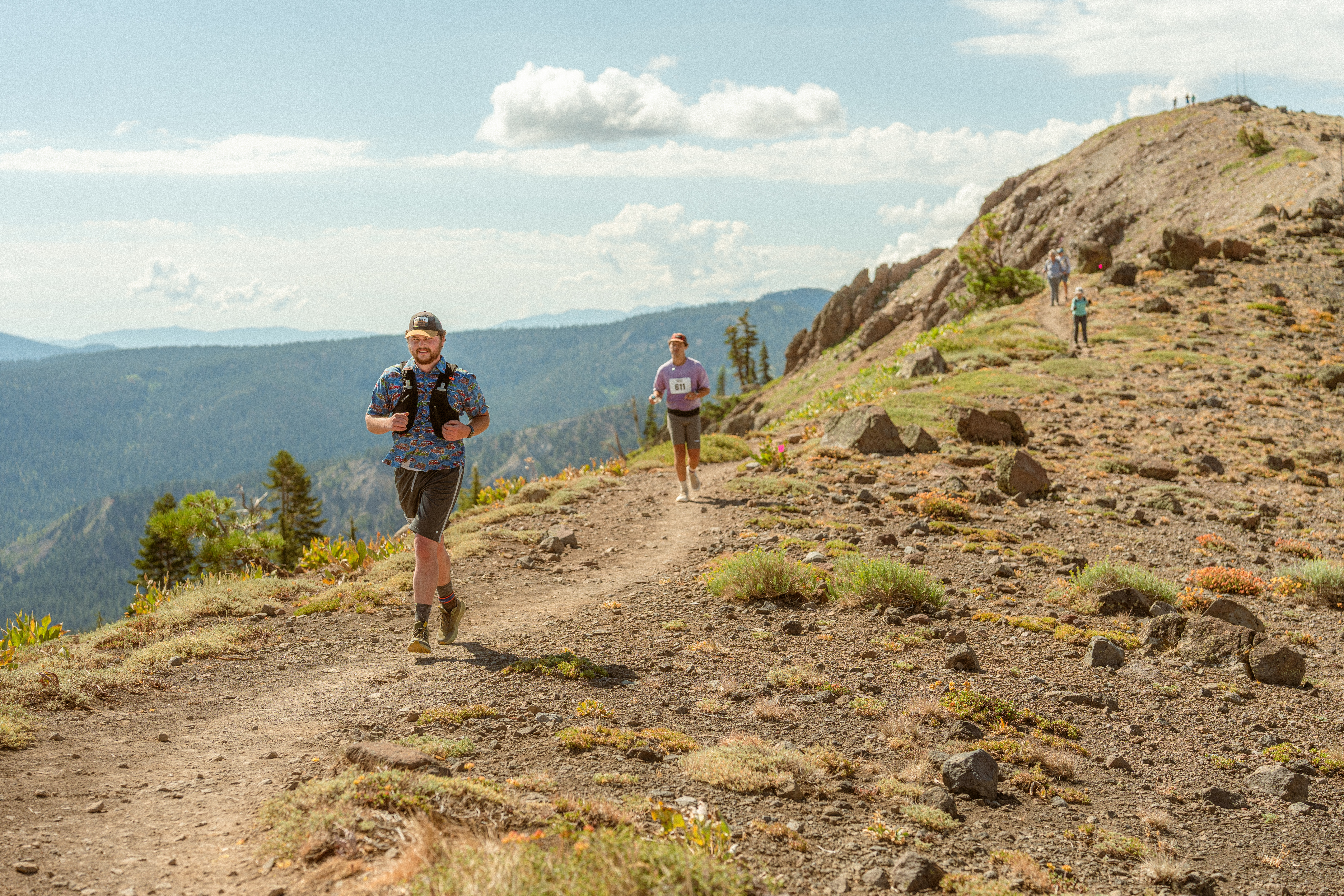
Of course there were four miles left in the race at that point. I ran along another ridge, and climbed to another peak before before beginning the long decent to the finish line. My legs felt like jelly by the end of it all but overall the inaugural Mountain Tiger Donner Summit race was a great experience, the event was well put together, the finish line was a place worth hanging out at and most importantly the course had the perfect mix of challenge and beauty. I’ll be signing up to run again in 2026 and likely more years to come.
After the Mountain Tiger race I was physically depleted, because of that (and some other factors) it would be a while before I ran consistently again, but once I did I found myself running much farther than I was before. The length of my average run went from three or four miles up to five or six with eight and nine mile distances not being uncommon either. Accomplishing hard things will force you to realize that your boundaries are much farther away than you thought they were. I believe the Mountain Tiger Donner Summit race unlocked those farther distances in my mind and I suddenly wasn’t satisfied with shorter runs anymore.
My ability to run far enhanced other things in my life. I spent a day at Lake Tahoe able to swim as far as I wanted without fear of becoming exhausted in the middle of the lake. I had a weekend trip to Salt Lake and running gave me the ability to explore the city when I didn’t have access to a car. Running while on camping trips also allowed me to explore places where people almost never step foot.
I believe we naturally crave exploration and traveling somewhere on foot is the purest form of exploration, the ability to run far allows you to satisfy that craving better than anything else can. Running makes the world around you much smaller, it is almost a super-power.
As the summer came to a close and we entered fall two more races loomed in the back of my mind. First was the Peavine Peak Hill Climb put on by local runner Darren Thomas, it is a 9.4 mile race to the top of Peavine and back down. I grew up at the base of Peavine but somehow had never been to the top, when I first saw that race on UltraSignup I knew I needed to run it.
For some reason, when I finally signed up for the hill climb I didn’t have the same level of confidence I did going into the Mountain Tiger race. That lack of confidence didn’t make much sense, I had completed the Mountain Tiger race which was harder in every way difficulty could be measured and I was fitter than I was then in every measurable way as well. I think it was the mountain itself providing the intimidation I was feeling. Peavine is the most prominent mountain around Reno, you can’t go anywhere without being able to see it, Peavine is literally the first thing you see when you walk out my front door. Peavine Peak loomed over me like the Eye of Sauron awaiting my demise.
Thankfully by the time race day came around I had regained my confidence. I woke up early and was one of the fist people to arrive at the start line, I picked up my bib then spent an hour talking to other runners out in the cold, I joked to a few that I might finish last.
The race began as the sun finally came up. It beat on our backs as we began to run up Chalk Canyon and I realized I had made a severe miscalculation with my clothing choice. Less than a mile had gone by when I took my gloves off and by the time I reached the aid station midway up the mountain my back was covered in sweat. That is where I chose to shed my top layer but that action was long overdue at that point, I should have done that at least a mile sooner.
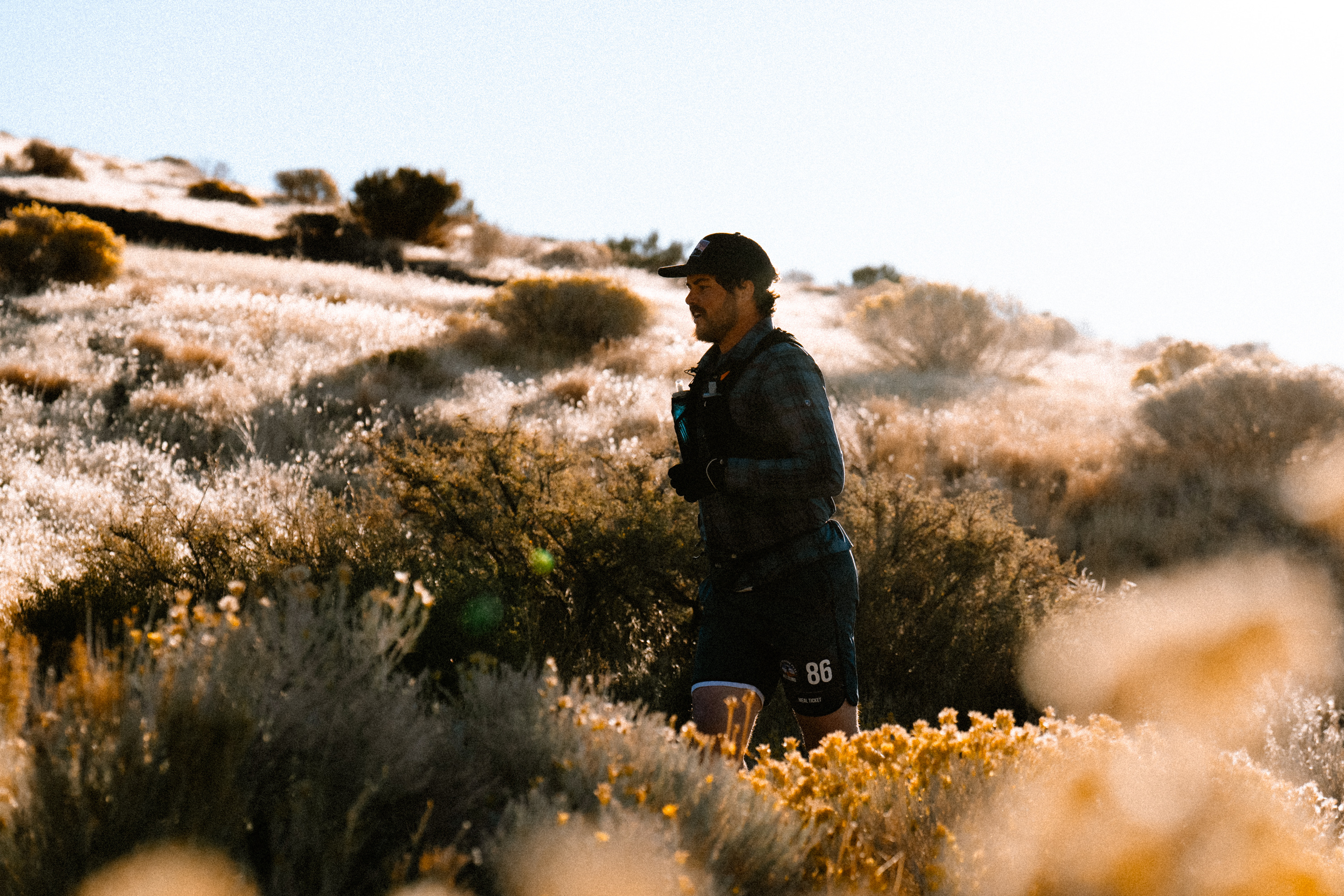
I left the aid station with a single potato chip having refused offers for a water refill. I then began the steep rocky section of the climb as I caught glimpses of the leaders of the race already running down. By the time I had reached the top the thin air at 8,000 feet and the fatigue of four miles had slowed me to the familiar pace from the Mountain Tiger race of ten steps followed by a pause to catch my breath.
I was the last person to make it to the top of the mountain in
exactly the hour and a half I
predicted it would take. It was rewarding to be at the top but that was
definitely the shortest amount of time I’ve ever spent at the top of a
mountain because at that point I had caught a second wind. I may have
been last to the top but despite my pre-race banter I didn’t want to be
last at the bottom and I gave myself the challenge to get down in half
the time it took me to get up.
Once I was out of the rocks and ice hiding in the shade I found myself on a smooth dirt road at a comfortable -10% grade. I passed five people by the time I got back to the aid station (which I blew right past) running under a 9 min/mile pace. The wind in my hair, the trail at my feet, and the views ahead all contributed to a wonderful decent.
Unfortunately those perfect conditions didn’t last long. As I was running down it felt like a large grain of sand had entered one of my shoes and it was causing pain in my heel at every step. By mile seven I couldn’t ignore the pain any longer and I found a rock off trail to sit down. I took off my shoe to find that there was no grain of sand, I realized that I was developing a large blister and I had no choice but to deal with that pain for the remainder of the race.
By the time I reached the finish line a blister had formed on my other foot as well, the blisters caused my pace to slow and my form to fall apart; I didn’t pass anyone else and I didn’t hit my goal of getting down the mountain in forty-five minutes but I also wasn’t passed by anyone so I wasn’t last. I stuck around for a bit to watch the last few people come in, meet some people and eat some free tacos. Aside from the silver dollar sized blisters on both my feet it was a good day and I felt great. The Peavine Peak Hill Climb is definitely something I’d recommend.
The next day I found myself on Ultrasignup.com again. By this point in time I had been following the sport of ultra running for about six months, I started paying attention to a few runners, tuned into a few race live streams and the podcast I most looked forward to listening to became The Next Aid Station. I wanted to experience the thing I’d been hearing stories about for months, but I didn’t know if I was ready. Earlier I had made a deal for myself that if I felt good after the Peavine Peak Hill Climb I’d sign up for one, and as you just read I felt great so I registered to run the 50k at the Ferris 50 Endurance Run and that race was only three weeks away.
This was the first Ferris 50, it takes place on dirt roads near the small town of Minden Nevada and I imagine it was dreamed up by someone who had learned the history of Leadville and wanted to bring money into their small community. (That isn’t confirmed, it is just my suspicion) I’m in no position to comment on the economic impact the Ferris 50 Endurance run had on Minden (although it seems to have been enough for the race to go on next year), I’m just here to talk about my experience as a runner.
When I signed up for the Mountain Tiger race I had never run twelve miles but I had run six so I felt like I had a good idea of how twelve would go. When I signed up for the Ferris 50 the twelve miles from that Donner Summit race was still the farthest I had ever run, and that wasn’t far enough for me to begin to comprehend how running 31 would go. Learning what that would be like was part of the reason I signed up.
A lot of ultramarathons, especially out here in the west, are characterized by their climbs, it seems like many course designers try to fit as much vert into their races as possible. The Ferris 50 was not like this, during the start line speech the race director mentioned that this was a fairly fast course, great for people to try to get a PR because it was relatively flat. This was one of the reasons that I chose the Ferris 50 to be my first ultra, a beginner like me is much more likely to survive an easy course than a hard one.
The first six or seven miles of the course contained the bulk of the climbing, the road and trails averaged about a 2.5% grade which was perfect because it was steep enough to keep me from going out too fast but not too steep to make me discouraged. I went out at a 12 min/mile pace that I knew I could maintain for a long time. How long I could maintain it was the question.
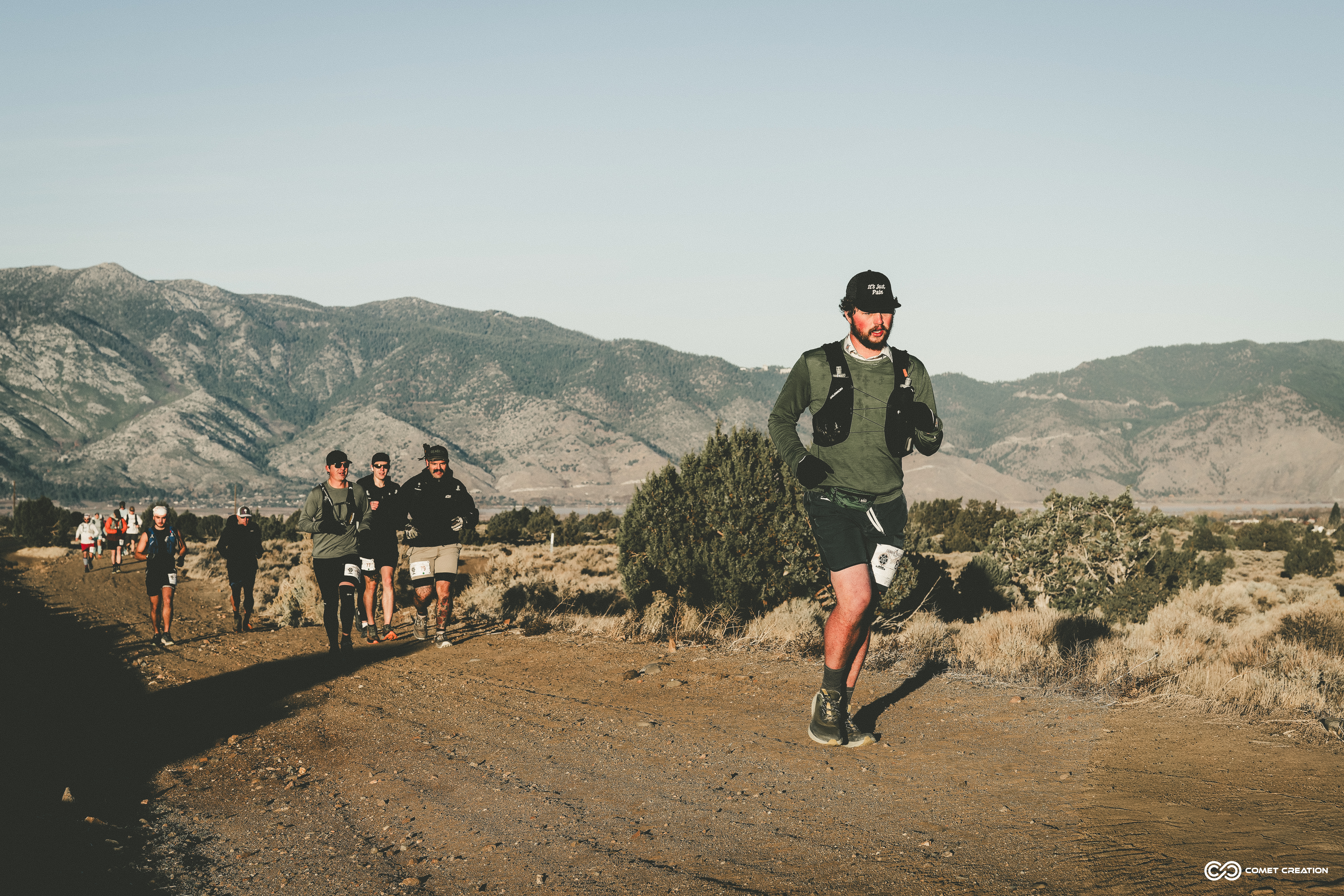
I got to the top of that hill and down to the aid station near mile 10 without much of a problem, I made sure to take my time there to shed my outer layer, fill up my water flasks and fuel up with some snacks. I left about five minutes later having drank the first bit of soda I’d had in at least six months and a handful of gummy bears.
I felt pretty good leaving that aid station, my second fastest mile of the day came soon after that and I made it to the next aid station near the halfway point of the race without slowing too much and still feeling fairly good. The gummy bears from the last aid station had messed with my stomach a bit so this time I fueled up mainly with grapes and watermelon. I chose not to sit down at all while I was there and I didn’t want to stay there too long, at this point I was on pace to finish the race around the seven hour mark and I wanted to keep pushing to finish around then. Evidently I didn’t seem to look as good as I felt because when I told the aid station volunteers I was leaving to continue the race they questioned my decision with a worried “Are you sure?”
From there the course took me on a five or six mile loop that would finish back at that same aid station. The first bit of that loop contained the steepest climb of the race, up about 500 feet over two miles not an insane climb but not one that is necessarily easy for a guy who had already ran about five miles further than he ever had before. I walked up most of that hill still feeling pretty good even though I hated the feeling of running north when I’d just have to turn to run back south at some point.
Midway through the loop was where the pain began, I had been pounding my feet against the trail for over four hours at this point and I could feel it. It was also the beginning of the isolation, up until this loop I had been near other runners, I had talked to a few of them throughout the day, but here it seemed there was a mile between me and another runner in either direction. I was alone wanting nothing more than to take the weight off my feet for a little bit but with no choice to press on. At one point I stopped to pee not because I really needed to pee but because I wanted an excuse to stop moving for a bit.

Eventually I made it back into the aid station and quickly found a chair to sit down it. I told myself I’d sit to let my feet recover for ten minutes but fifteen passed in what felt like five as I refueled with grapes, watermelon and a quesadilla. I could have stayed longer but I knew I had to go and I found myself saying goodbye to that aid station once again as I began my eight mile trek back into town.
It would be hours before I saw another 50K runner. After mile 23 I finally decided to put on my headphones and listen to some music so that my mind could wander a bit. In the moment I didn’t feel like the music was very helpful but looking back at my splits the first mile I spent listening to music was by far my fastest mile of the second half of the race so it must have done something.
A while later a few runners flew past me like I was standing still. I was confused at first but later realized they were the leaders of the 50 mile race who had started running and hour before I did. When I first learned of the Ferris 50 months earlier I wanted to run the 50 mile race rather than the 50K, I thought I would have enough time to put in the necessary training for a 50 miler. I had asked friends if I would be a wuss if I chose the 50K over the 50 mile. When it finally came time for me to sign up I knew I wasn’t in shape for a 50 mile race because I hadn’t done the necessary training but I was pretty sure I could make it through a 50K. As I ran I realized that nobody who runs a 50K is a wuss. I was glad I didn’t sign up for the 50 mile that day.
Somewhere around mile 27 I made it to the last aid station and the guys there were all great. When I fist got to the aid station someone came up to me with a printed map and energetically said something along the lines of, “You’re almost done, you got this, you only have four miles to go, you’ll run to the end of this road, take a right then take a left on the next road and you’ll follow that all the way to the finish.” I appreciated the energy, encouragement, and enthusiasm of everyone there, at that point in the race I didn’t have much of any of those things. Everyone there believed I could finish, I did too but I needed to sit down and eat a bunch of grapes and potato chips first.
When I left that aid station refueled I was thankful to be running on pavement. Dodging rocks along an uneven surface takes a lot of extra energy. Generally I enjoy trail running more than road running but at that point I was happy that the trails were behind me and I had nothing but flat consistent asphalt for the rest of the day.
Of course that didn’t mean the rest of the race was easy, I was running on empty barely able to run 100 yards at a time. The strategy that got me through was to take things one small landmark at a time. There were reflectors along the side of the road, I’d push myself to run to one reflector and let myself walk to the next. It was slow going, sometimes I’d stop short of a reflector, sometimes I’d need to walk past two before I could run again, and sometimes I’d be able to run twenty yards farther than I thought I could. Those certainly felt like my slowest miles of the race but it turns out I got through miles 28 to 31 much faster than I did miles 25 to 28, that strategy was probably the reason for that.
The longest stretch of any race is the distance between the point where your watch says you’ve run the distance of the race and the actual finish line. You can never know what that distance will be but for me on that day that distance was close to a full kilometer. It was by far the worst kilometer of the race because I just wanted to be done, I walked most of it but when the finish line was finally within reach I ran with whatever energy I had left and finished the Ferris 50K in 24th place out of 32 with a time of 7:57:26.
After crossing the finish line I headed straight to the nearest chair to sit down. Naturally my dad wanted to take a picture and I told him I wasn’t going to stand back up for it. Eventually I hobbled back to the car at a pace much slower than the average octogenarian. The next day I felt surprisingly fine, I sat through church having almost forgotten what I had put my body through the day before, only reminded of it when I struggled to stand up from my pew with incredibly sore legs. By Monday afternoon I was back to running and I had no problem running just as fast as I had before the race.
Now I’ve spent over five thousand words explaining how I got to the point of running a 50K but I still haven’t answered the question of why. The other night I was watching a video documenting a guy suffering through a 100 mile race and as I was watching him suffer I caught myself asking, “Why does this appeal to me? I am seeing this man suffer, but why does it make me want to try the same thing?”
The appeal of the ultramarathon is not something I feel like I can put into words. In the book The Explorer’s Gene Alex Hutchinson explains that it appears some people seem to be wired for adventure and exploration, wired to test the limits, we all crave it at some level but for some that craving is more extreme than for others.
After I finished the Ferris 50 I felt like that craving had been satisfied, I knew what the pain of an ultramarathon felt like, I didn’t need to do another. I could say that I’ve been there and done that. But the satisfaction didn’t last long, I soon found myself looking at other races. On a Tuesday morning I sat in my work truck with my credit card out signing up to run the Broken Arrow 46K seconds after registration for the event opened. Only after my payment was processed did the fear and adrenaline hit as I realized I had just signed up for one of the hardest races in the country, it was hard to focus on much else that day.
So why did I run a 50K? I ran it because I had to, to satisfy my need for adventure, that is something you will either understand or something you won’t. It appears that I am stuck on the ultramarathon train for a while now, I don’t know how long this ride will be or where I will get off, right now I just have to enjoy the ride.
“Why do I run?” is the easier question to answer. I run because we all have to. Fitness is not something we can afford to neglect and you cannot call yourself fit if you cannot run. If you take the advice that Peter Attia gives in his bestselling book Outlive everyone should be spending at least three hours a week running at an easy pace. Our bodies were made to run, we are wasting a gift if we don’t.
But more importantly running is something I have come to enjoy. The satisfaction of completing something hard, the thrill of exploring new places, and the time to reflect that the empty trails can provide are all things that are hard to find in other activities, they definitely can’t be found staring at some screen. Sure there are some days where getting out the door is harder than normal, days where the run hurts more than usual, and days when legs just won’t cooperate, but despite all that I’ve found that I never regret going on a run, I only regret failing to step out the door. I don’t want you to live with that regret, get yourself a good pair of shoes and see where your feet can take you.